Buy debt.me.uk ?
We are moving the project
debt.me.uk .
Are you interested in purchasing the domain
debt.me.uk ?
domain@kv-gmbh.de · 0541-91531010
Buy debt.me.uk ?
What is a trapezoid?
A trapezoid is a quadrilateral with at least one pair of parallel sides. The parallel sides are called the bases of the trapezoid, and the non-parallel sides are called the legs. The height of a trapezoid is the perpendicular distance between the two bases. The area of a trapezoid can be calculated using the formula A = (1/2) * (b1 + b2) * h, where b1 and b2 are the lengths of the two bases and h is the height. **
What is the difference between an isosceles trapezoid and an equilateral trapezoid?
An isosceles trapezoid has two sides that are equal in length, while an equilateral trapezoid has all four sides of equal length. In an isosceles trapezoid, the non-parallel sides are of equal length, whereas in an equilateral trapezoid, all four sides are equal. Additionally, the angles in an isosceles trapezoid may be different, while in an equilateral trapezoid, all angles are equal. **
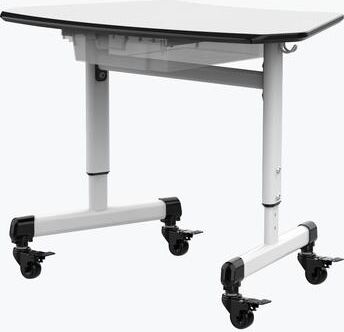

Similar search terms for Trapezoid
Top-Angebote
Products related to Trapezoid:




-
What is the difference between an isosceles trapezoid and a symmetric trapezoid?
An isosceles trapezoid is a type of trapezoid where the non-parallel sides are congruent, meaning they have the same length. This results in two of the angles being equal in measure. A symmetric trapezoid, on the other hand, is a trapezoid with a line of symmetry, meaning that if the trapezoid is folded along this line, the two halves will perfectly overlap. This means that the non-parallel sides of a symmetric trapezoid are not necessarily congruent, but the trapezoid has a line of symmetry. **
-
What is a mathematical trapezoid?
A mathematical trapezoid is a quadrilateral with at least one pair of parallel sides. The parallel sides are called the bases of the trapezoid, and the other two sides are called the legs. The height of a trapezoid is the perpendicular distance between the two bases. The area of a trapezoid can be calculated using the formula: 1/2 * (sum of bases) * height. **
-
Is every trapezoid a parallelogram?
No, not every trapezoid is a parallelogram. A trapezoid is a quadrilateral with at least one pair of parallel sides, while a parallelogram is a quadrilateral with both pairs of opposite sides parallel. Therefore, a trapezoid can have only one pair of parallel sides, while a parallelogram has both pairs of opposite sides parallel. So, while some trapezoids can be parallelograms, not all trapezoids are parallelograms. **
-
Is every square a trapezoid?
No, not every square is a trapezoid. A trapezoid is a quadrilateral with at least one pair of parallel sides, while a square is a special type of quadrilateral with four equal sides and four right angles. Since a square has two pairs of parallel sides, it meets the definition of a trapezoid, but not all trapezoids have four equal sides and four right angles like a square. Therefore, while a square can be considered a trapezoid, not every trapezoid is a square. **


What is an isosceles trapezoid?
An isosceles trapezoid is a quadrilateral with two parallel sides of unequal length and two non-parallel sides of equal length. The two non-parallel sides are called the legs, and the two parallel sides are called the bases. The angles between the bases and each leg are congruent, making it a special type of trapezoid. The diagonals of an isosceles trapezoid are also congruent, and the midpoint of the diagonals forms a right angle. **
Can you please help me construct an isosceles trapezoid?
To construct an isosceles trapezoid, start by drawing a horizontal line for the longer base of the trapezoid. Then, draw two diagonal lines from the ends of the longer base, angling them towards each other. These lines should be of equal length to create the two equal sides of the trapezoid. Finally, connect the ends of the diagonal lines with a shorter horizontal line to complete the trapezoid. Make sure that the angles between the longer base and the diagonal lines are equal to ensure that the trapezoid is isosceles. **
Top-Angebote
Products related to Trapezoid:
-
What is a trapezoid?
A trapezoid is a quadrilateral with at least one pair of parallel sides. The parallel sides are called the bases of the trapezoid, and the non-parallel sides are called the legs. The height of a trapezoid is the perpendicular distance between the two bases. The area of a trapezoid can be calculated using the formula A = (1/2) * (b1 + b2) * h, where b1 and b2 are the lengths of the two bases and h is the height. **
-
What is the difference between an isosceles trapezoid and an equilateral trapezoid?
An isosceles trapezoid has two sides that are equal in length, while an equilateral trapezoid has all four sides of equal length. In an isosceles trapezoid, the non-parallel sides are of equal length, whereas in an equilateral trapezoid, all four sides are equal. Additionally, the angles in an isosceles trapezoid may be different, while in an equilateral trapezoid, all angles are equal. **
-
What is the difference between an isosceles trapezoid and a symmetric trapezoid?
An isosceles trapezoid is a type of trapezoid where the non-parallel sides are congruent, meaning they have the same length. This results in two of the angles being equal in measure. A symmetric trapezoid, on the other hand, is a trapezoid with a line of symmetry, meaning that if the trapezoid is folded along this line, the two halves will perfectly overlap. This means that the non-parallel sides of a symmetric trapezoid are not necessarily congruent, but the trapezoid has a line of symmetry. **
-
What is a mathematical trapezoid?
A mathematical trapezoid is a quadrilateral with at least one pair of parallel sides. The parallel sides are called the bases of the trapezoid, and the other two sides are called the legs. The height of a trapezoid is the perpendicular distance between the two bases. The area of a trapezoid can be calculated using the formula: 1/2 * (sum of bases) * height. **
Similar search terms for Trapezoid
-
Is every trapezoid a parallelogram?
No, not every trapezoid is a parallelogram. A trapezoid is a quadrilateral with at least one pair of parallel sides, while a parallelogram is a quadrilateral with both pairs of opposite sides parallel. Therefore, a trapezoid can have only one pair of parallel sides, while a parallelogram has both pairs of opposite sides parallel. So, while some trapezoids can be parallelograms, not all trapezoids are parallelograms. **
-
Is every square a trapezoid?
No, not every square is a trapezoid. A trapezoid is a quadrilateral with at least one pair of parallel sides, while a square is a special type of quadrilateral with four equal sides and four right angles. Since a square has two pairs of parallel sides, it meets the definition of a trapezoid, but not all trapezoids have four equal sides and four right angles like a square. Therefore, while a square can be considered a trapezoid, not every trapezoid is a square. **
-
What is an isosceles trapezoid?
An isosceles trapezoid is a quadrilateral with two parallel sides of unequal length and two non-parallel sides of equal length. The two non-parallel sides are called the legs, and the two parallel sides are called the bases. The angles between the bases and each leg are congruent, making it a special type of trapezoid. The diagonals of an isosceles trapezoid are also congruent, and the midpoint of the diagonals forms a right angle. **
-
Can you please help me construct an isosceles trapezoid?
To construct an isosceles trapezoid, start by drawing a horizontal line for the longer base of the trapezoid. Then, draw two diagonal lines from the ends of the longer base, angling them towards each other. These lines should be of equal length to create the two equal sides of the trapezoid. Finally, connect the ends of the diagonal lines with a shorter horizontal line to complete the trapezoid. Make sure that the angles between the longer base and the diagonal lines are equal to ensure that the trapezoid is isosceles. **
* All prices are inclusive of VAT and, if applicable, plus shipping costs. The offer information is based on the details provided by the respective shop and is updated through automated processes. Real-time updates do not occur, so deviations can occur in individual cases. ** Note: Parts of this content were created by AI.